The most expensive mistakes in cannabis, hemp and CBD marketing often happen before the first post: a product is misclassified, a promise is repeated without review, or a channel is included in the plan even though the campaign is not eligible to run there.
The result is not just wasted budget. Legal exposure, rejected campaigns and damaged trust can follow. Professional brands need more than strong creatives: a clear product category, supportable messages and a strategy that fits the audience. They also need practical solutions – from stage sponsorship with musicians and comedians to suitable TV placements and long-term creator partnerships.
This article connects marketing practice with selected legal guardrails for Germany and the EU. Reviewed on 14 October 2026. It is not legal advice or individual product clearance. Platform policies and authorisation status must be checked again before each campaign.
1. Treating cannabis, hemp and CBD as one category
A hemp-fibre jacket, a CBD food product, a prescription cannabis medicine and a cultivation accessory need different briefs. A shared connection to the plant does not replace classification.
The German KCanG expressly distinguishes between them: CBD, industrial hemp and medical cannabis are excluded from its definition of cannabis. Whether a specific product qualifies for an exception, and which other rules apply, requires separate assessment. Source: Section 1 KCanG.
A better approach: Establish exactly what is being promoted, its composition and intended purpose, the target country and the audience before creative development. “Hemp” on the packaging is not legal clearance.
2. Mistaking partial legalisation for permission to advertise
Section 6 KCanG prohibits advertising and sponsorship for cannabis within the Act’s scope and for cultivation associations. Section 10 HWG restricts advertising prescription-only medicines to the professional recipients it specifies. These are different frameworks, not a shared marketing green light. Sources: Section 6 KCanG, Section 10 HWG.
A B2B label, event sponsorship or creator collaboration is therefore not an automatic exception. The KCanG’s definition of advertising also covers indirect promotion. Source: Section 1, point 14 KCanG.
A better approach: Have the actual message, effect and recipients assessed – not just the label “community”, “education” or “brand placement”.
3. Selling through health promises without reviewing the claim
“Helps with anxiety”, “improves your sleep” and “relieves pain” are illustrative examples of statements that may trigger medical or health-claim requirements, depending on the product. They are not suggested advertising copy.
For foods, the health-claims framework covers presentation and advertising as well as labels. The European Commission points businesses to a register of permitted or authorised claims. A scientific paper alone does not replace the required legal basis and conditions of use. Source: European Commission – Nutrition and Health Claims.
A better approach: Keep an approved claim register: wording, relevant product, evidence, conditions and clearance date. Include creator briefs, product pages, subtitles and newsletters in the same review process. Republished customer testimonials can also carry problematic promises.
4. Checking CBD marketability only after launch
A campaign cannot repair a missing product authorisation. The European Commission records novel-food classifications for various CBD isolates and extracts; novel foods generally require pre-market authorisation. This is not a blanket statement about every hemp food or cosmetic product. Sources: CBD status consultations, European Commission – Novel Food.
A better approach: Document the ingredients, status and, where relevant, authorisation and conditions for the specific food product. An application in progress, a laboratory report or another shop selling it is not, on its own, proof of authorisation. Where uncertainty remains, involve the competent authorities or specialist counsel.
5. Confusing the law, paid ads and organic content
A lawful product is not automatically eligible for advertising on every platform. An accepted ad does not make an offer lawful either.
Google’s policy prohibits, among other things, advertising recreational drugs and accessories marketed for that purpose. Its CBD rules contain product, location and certification conditions. Exceptions or pilot programmes in other countries cannot simply be transferred to Germany. Source: Google Ads – Recreational drugs.
A better approach: Review each channel separately: organic content, paid advertising, branded content, commerce features and the destination page. Record policies, permissions and rejection reasons. Hidden product destinations, disguised wording or new accounts to evade a suspension are not a sustainable strategy.
6. Treating creators as an advertising loophole
Personal connection does not automatically make commercial content private. Compensation can trigger disclosure requirements; affiliate links and gifted products also belong in the assessment. Advertising must be clearly recognisable. Disclosure does not, however, make prohibited advertising permissible. Sources: Media Authority of North Rhine-Westphalia, Section 5a(4) UWG.
A better approach: A creator brief defines the role, statement boundaries, disclosures, links, usage rights and approvals. It contains more than “be authentic”. The same applies to reposts, paid reuse and extended campaign periods.
7. Booking by follower count instead of personal fit
The largest audience is not automatically the right one. A music format, a food vlog and a hosted discussion serve different purposes. Putting a face inside the scene does not replace a credible connection between the person, product and audience.
Our roster illustrates these differences: Inspecta brings music and live presence, Leomusslos connects lifestyle, fitness, food and cannabis, and Luna Luxx brings hosting, camera presence and her own range of interests. The specific campaign fit matters more than simply sharing an industry.
A better approach: Examine formats, audiences, regional relevance and comparable reporting periods. Views over 90 days provide context – not a guaranteed campaign result. Audiences across multiple creators may overlap; views and accounts reached are not the same metric.
8. Reducing the community to a stereotype
Being cannabis-affine does not mean everyone shares the same interests, circumstances or expectations. Hemp fashion, food, accessories, wellness topics and medical information need different tones. One generic “420” look can obscure those differences.
A better approach: Understand real situations, language and motivations. Age-appropriate communication, suitable environments and avoiding targeting minors belong in the brief. An “18+” label alone replaces neither this work nor legal clearance.
9. Building reach without a useful next step
A strong reel achieves little if the link is unclear, the website fails to explain the message or an appropriate B2B enquiry ends up in the wrong form. An event without preparation and follow-up can also remain an isolated activity.
A better approach: Build a coherent journey: attention → relevant information → a permissible, clear next action. Product information, websites and shops, suitable creator formats and events should work together. Owned channels reduce platform dependence, but they are not exempt from the law. Measurement and consent also belong in the plan.
10. Leaving compliance until the final revision
If a claim, visual concept or product category is challenged only after a shoot, much of the budget is already committed. Legal review and strong design are not opposites: clear guardrails give creative work a reliable space to operate.
A better approach: Define the approval chain in advance. Who confirms product status? Who reviews statements? Who checks the destination page? Who can publish? Who responds to questions or rejections? A documented decision is more useful than a scattered “looks fine” in a chat.
The solutions we build: stages, screens and long-term partnerships
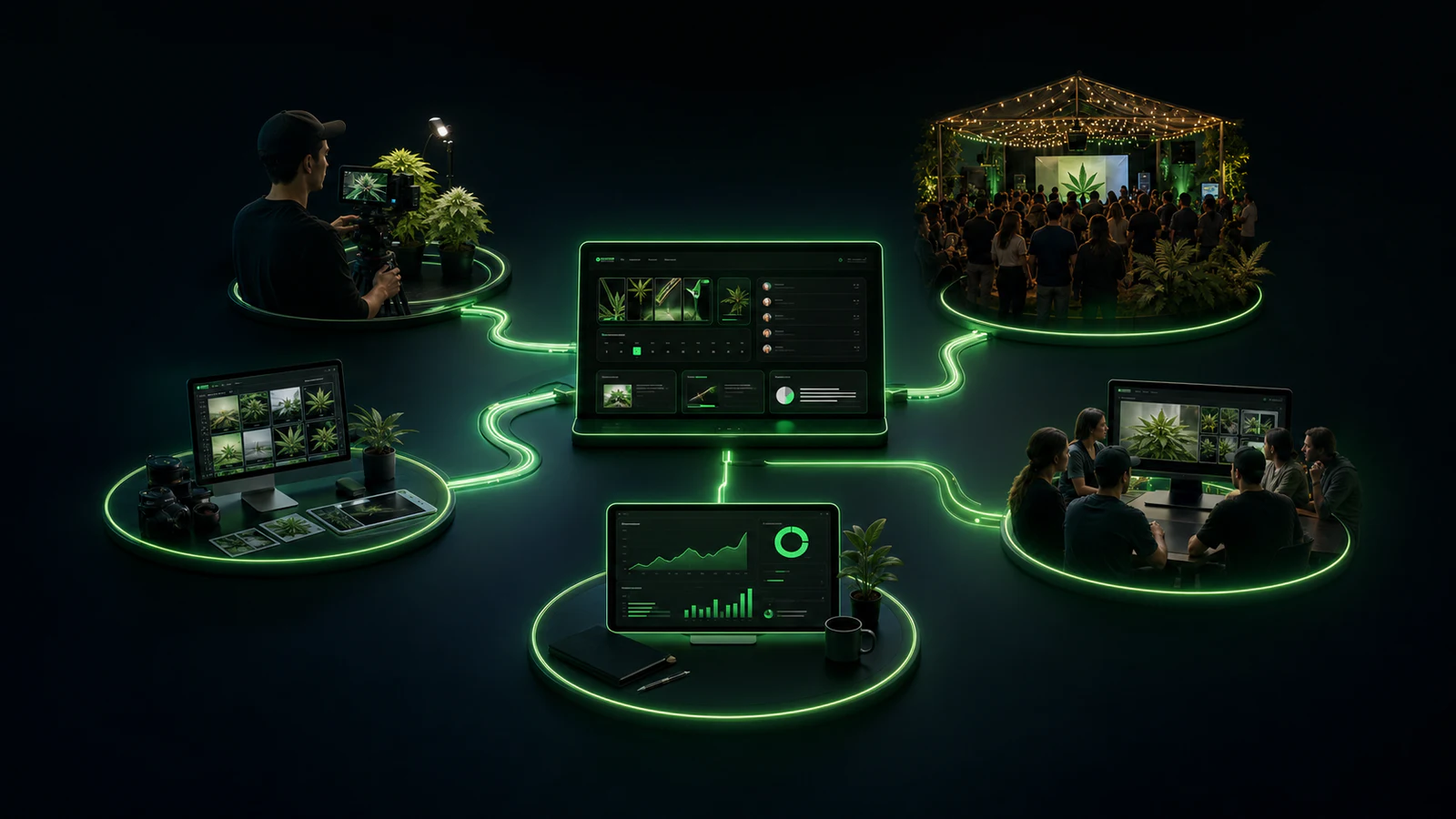
Not every brand needs the same channels. The right question is: In which permissible setting can the brand be experienced credibly – and how do we create recurring touchpoints there? For suitable products and brands, we develop partnerships that connect live stages, formats and content.
The boundary remains clear: these options are not ways around advertising or sponsorship bans. The product, brand, message, audience and setting must be reviewed together. Even an apparently neutral logo may indirectly promote cannabis in its overall context. Sources: Section 1 KCanG, Section 6 KCanG.
Stage sponsorship with musicians and comedians
For legally eligible brands, working with musicians or comedians can be more than a logo for one evening: a partnership across a series of shows, a tour or recurring live formats. The brand meets an audience that has deliberately chosen a personality and an experience.
Possible components, each subject to clearance:
- Brand visibility on agreed stage surfaces, tour materials or event media.
- A relevant partner area or supporting activation at the venue.
- Backstage and behind-the-scenes content with image, music and usage rights agreed.
- Recurring communication before, during and after performances.
Our approach: Select the artist, programme, audience and brand role together. On-stage visibility and later publication of recordings are separate clearance questions. The show remains the show; a sponsorship agreement is not unrestricted permission for product or consumption advertising.
Product placement in suitable TV and video formats
A permissible product can become part of a credible scene in a suitable format: for example, hemp fashion as wardrobe, a legally reviewed food product or a suitable lifestyle accessory. Product category, programme type and approval from the production and broadcaster or platform matter more than the desired screen exposure.
Product placement is not undisclosed advertising. Broadcasting rules include requirements for disclosure, editorial independence and the intensity of the presentation. Not every format or product is eligible. Source: German media authorities’ Advertising Statute, particularly Section 10.
Our approach: Identify suitable productions, develop a coherent integration and coordinate it with the responsible parties. Placement scope, usage rights and any supporting content activity are agreed in advance. We only commit to a specific TV placement once availability, contracts and clearances are confirmed.
Long-term creator partnerships instead of isolated sponsored posts
Creator partnerships can support a brand across multiple formats: reels, stories, posts, vlogs, YouTube videos, podcasts or hosted talk formats. Rather than finding a new face for every activation, the collaboration builds a recognisable connection between brand, personality and subject matter.
Depending on the fit, we develop recurring content series, transparent product integrations, event coverage or longer-term format partnerships. A food or lifestyle subject needs a different person and narrative from a music project or a talk.
Our approach: Select the right creator, develop a shared format idea and agree on duration, disclosures, claims, approvals and usage rights. A reviewer’s personal assessment must not be replaced by a prescribed positive verdict. Legal requirements and platform policies also apply to long-term collaborations.
Consistent execution: a placement system, not isolated activations
These are the connections we want to build continuously with brands. Our goal is not a one-off logo moment, but ongoing presence with a clear narrative. Based on individual agreements, we plan a connected implementation:
- Strategy and guardrails: Assess the product, brand, audience, suitable settings and open legal questions.
- Partners and formats: Select relevant artists, creators and productions; agree scope, budget, rights and approvals.
- Pilot and rollout: Start with an approved format and expand suitable components into a recurring collaboration.
- Content and next steps: Connect live moments, supporting content and the brand’s own website within the agreed, permissible scope.
- Review and development: Assess relevant contacts, content response and agreed objectives; refine formats and partners regularly.
Not every collaboration needs all three routes at once. Sometimes a strong creator series is the right starting point; sometimes it is a stage partnership or a carefully coordinated placement. For us, consistency means working strategically, executing reliably and learning from the results – not putting the same logo everywhere.
The pre-launch campaign checklist
- Product, intended purpose and target market clearly classified?
- Marketability and relevant documentation established for the specific product?
- Advertising and sponsorship boundaries reviewed with qualified legal counsel?
- Claims, visuals, testimonials and destination pages approved?
- Current channel rules checked for the exact format and country?
- Audience, age-appropriate communication and creator fit understood?
- Disclosures, usage rights and approvals agreed in writing?
- Stage, recording, production and broadcaster clearances established for the planned placements?
- Partnership duration, recurring formats and responsibilities defined?
- Measurable goals, comparable metrics and a suitable customer journey in place?
- Owners appointed for publishing, monitoring and corrections?
Strong strategy starts before the first ad
Professional cannabis, hemp and CBD marketing is not about finding clever ways around restrictions. It is about identifying permissible opportunities carefully and building a distinctive brand within them: clear messages, relevant partnerships and channels that work together.
420BRANDS supports positioning, campaign concepts, brand and product placement, content, creator and artist placement and event activation. We work with brands on an ongoing placement and partnership strategy – using suitable stage, TV and creator formats rather than isolated activations. We structure the marketing brief and flag open legal questions; binding legal clearance remains with specialist counsel.
Want to explore the right direction for your brand? Talk to us about a non-binding Brand Sprint. If your website is the first priority, our Website Check is a starting point for technical and communication improvements – not an assessment of legal product marketability.
Primary sources & legal basis
- Section 1 KCanG – Definitions and distinctionsGerman Federal Ministry of Justice / Federal Office of Justice
- Section 6 KCanG – General ban on advertising and sponsorshipGerman Federal Ministry of Justice / Federal Office of Justice
- Section 10 HWG – Advertising prescription-only medicinesGerman Federal Ministry of Justice / Federal Office of Justice
- Nutrition and Health Claims – food advertisingEuropean Commission
- CBD isolates and extracts – status consultationsEuropean Commission
- Novel Food – pre-market authorisationEuropean Commission
- Google Ads – Recreational drugs and CBD productsGoogle Ads
- Advertising disclosures in online mediaMedia Authority of North Rhine-Westphalia
- Section 5a UWG – Disclosure of commercial intentGerman Federal Ministry of Justice / Federal Office of Justice
- Advertising Statute – broadcasting product placement and sponsorshipGerman media authorities